The Distinct Appeal and Practical Considerations of Masha Studio's Easter Bunnies Clipart
In the world of digital art assets for creative projects, clipart collections serve as foundational tools. When evaluating these resources, the specific characteristics of the artwork, its licensing terms, and its practical applicability are paramount. The Easter Bunnies Clipart by Masha Studio represents a particular category of asset, and understanding its distinct attributes can help creators determine if it aligns with their project needs.
What Defines This Clipart Collection
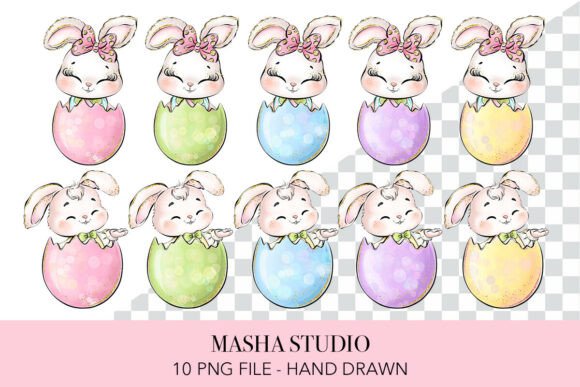
Masha Studio's Easter Bunnies Clipart is a set of ten hand-drawn illustrations centered on Easter bunny themes. The key specifications are clearly outlined: PNG files on a transparent background, a height of 12.4 inches, high resolution at 300dpi, and sRGB color profile. These technical details are not merely promotional points; they are functional descriptors that directly impact usability. A 300dpi resolution is suitable for both digital and high-quality print applications, such as the mentioned planner stickers or fabric printing, while the sRGB profile ensures color consistency across most screens and consumer-grade printers.
The "hand-drawn" style is a significant differentiator. Compared to vector-based clipart or highly stylized digital illustrations, hand-drawn artwork often carries a softer, more whimsical, and less geometric aesthetic. This can imbue projects with a sense of organic charm and warmth, which is particularly desirable for themes like Easter, birthdays, or home decorations. The Easter Bunnies Clipart by Masha Studio likely occupies a niche between ultra-polished commercial graphics and more rough, sketch-style art, offering a balance of character and clarity.
Evaluating the Range of Application and Licensing
The listed use cases—from planner stickers and sublimation designs to T-shirts and wall art—demonstrate the collection's versatility across physical and digital mediums. The high resolution and large base size support scalability, meaning a single image could be used for a small mug decoration or enlarged for a wall canvas without loss of quality. This flexibility is a core strength. However, versatility also depends on the artistic composition itself. Bunny illustrations that are overly detailed or context-dependent might not adapt as seamlessly to all surfaces compared to more iconic, simplified designs. A prospective user should assess the individual bunny poses and elements within the Easter Bunnies Clipart by Masha Studio to see if they fit the specific dimensions and layouts of their intended projects, like tumblers or 3D cardmaking.
Equally critical is the licensing framework. The permissions explicitly allow for a broad spectrum of creative projects, which is advantageous for crafters, small business owners, and hobbyists. The restrictions, however, are very specific and define the boundaries of use. Prohibitions include giving the art for free, re-selling the designs as-is, uploading to automated merchandise marketplaces (Spoonflower, Society6, etc.), and using the art to create new seamless patterns or derivative clipart. This places the Easter Bunnies Clipart by Masha Studio in a category distinct from both fully unrestricted public domain art and from more commercial licenses that permit mass merchandising. It is best suited for personalized, finished projects where the artwork is an integrated component, not the product itself.
Comparative Context and Alternative Approaches
When considering resources for Easter-themed designs, creators have several avenues. One alternative is creating original artwork, which offers complete creative control and unique licensing freedom but requires significant time, skill, and tools. Another is using stock illustration subscriptions from large platforms, which provide vast libraries but often come with recurring costs and more complex, tiered licenses that may or may not cover physical merchandise. Free clipart found online can be tempting, but frequently suffers from low resolution, unclear licensing, and inconsistent quality.
Compared to these common alternatives, a specialized set like the Easter Bunnies Clipart by Masha Studio offers a middle path. It provides a cohesive, high-quality bundle with clear, one-time acquisition terms focused on end-product creation. Its tradeoff is in scope: it is a focused set of ten bunny images, not a vast library of all Easter symbols. Therefore, if a project requires extensive variety—including eggs, chicks, fonts, and backgrounds—this collection alone might be insufficient. It would serve excellently as a core visual element, but might need to be complemented with other assets for more complex designs.
Identifying the Best-Fit Situations
Determining whether this clipart collection is the right choice involves matching its attributes to your project parameters. The Easter Bunnies Clipart by Masha Studio is likely an excellent fit for several scenarios. For a small business creating limited-run, customized products like party decorations or personalized greeting cards, the license supports this directly. For a crafter engaged in scrapbooking or making gifts, the hand-drawn style adds a personal touch that might be harder to achieve with generic vector art. The technical specs reliably support sublimation and fabric printing, making it a practical option for those ventures.
Conversely, there are situations where another option would be necessary. If your goal is to create a brand-able pattern for a textile line to be sold on a marketplace like Spoonflower, the license explicitly forbids this. If you need hundreds of variations of Easter assets for a large-scale digital application, the limited count of ten images might be a constraint. Also, if your design aesthetic requires ultra-modern, minimalist, or photorealistic graphics, the hand-drawn charm of this set might not align.
Key Decision Factors for Creators
Making an informed decision requires weighing a few concrete factors beyond just the aesthetic appeal of bunnies.
- Project Scope and Scale: Assess whether ten high-resolution images provide enough core material for your entire project or if they will function as accents within a larger design scheme.
- Licensing Alignment: Scrutinize your intended final use. Are you creating finished, personalized goods? Or are you aiming to sell the digital design itself on a print-on-demand platform? The latter conflicts with the terms.
- Style Cohesion: Evaluate if the hand-drawn style complements your other design elements, brand identity, or the desired emotional tone of your project.
- Technical Requirements: Confirm that the PNG format, transparent background, and 300dpi resolution meet the technical needs of your production process, whether for digital editors or specific printing equipment.
It's also worth considering the efficiency a curated bundle offers. Searching for and licensing multiple individual bunny illustrations from disparate sources can be time-consuming and lead to stylistic mismatches. A coherent set like Easter Bunnies Clipart by Masha Studio provides consistency and reduces that administrative overhead.
Practical Integration and Final Considerations
In practical use, integrating such clipart into projects involves more than just placement. The large file size (12.4 inches high) allows for cropping and focusing on specific elements of a bunny illustration without starting from a pixel-limited base. For example, you might use just the face of a bunny for a sticker and the full body for a T-shirt design, all from the same file. This maximizes the utility of each image.
Ultimately, resources like the Easter Bunnies Clipart by Masha Studio exist to solve specific creative problems: providing quality, licensed artwork that enables the creation of derivative end-products with a distinct aesthetic. Its value is not universal but situational. For the creator who needs a reliable, charming, and technically sound set of Easter bunny graphics for hands-on craft or small-scale commercial projects—and whose plans respect the clear licensing boundaries—this collection represents a focused and practical solution. For those with needs outside these parameters, exploring broader stock libraries, commissioning custom art, or utilizing different asset types remains the advisable path. The decision hinges on a clear assessment of your project's functional requirements, stylistic goals, and intended distribution, allowing you to match the resource to the task effectively.